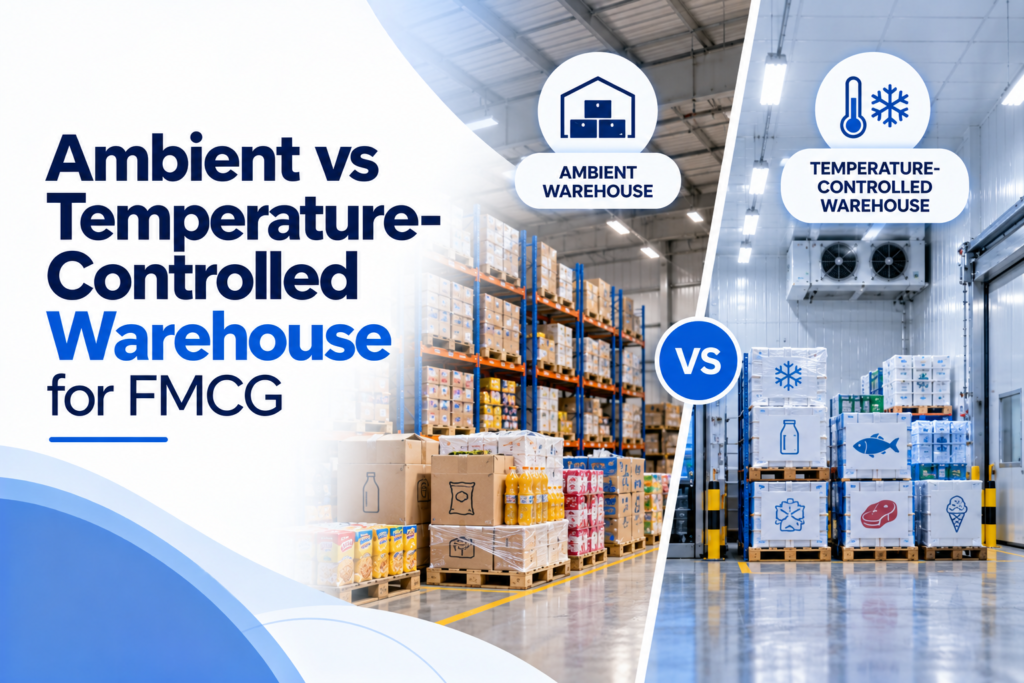
Ambient warehouse storage has no cooling, so its temperature follows the weather, while temperature-controlled storage holds a set range. Use ambient only for products whose pack and shelf life tolerate Indian summer heat. Move any product whose storage statement sets a ceiling into controlled space.
For a head of supply chain at an FMCG, confectionery or personal care brand, the question is whether storage honours the pack. This guide compares the two, shows how to check each SKU against its label, and explains when moving a category pays off.
| Short answer Store a product in ambient space only if its pack statement and shelf life hold at the warmest conditions the warehouse reaches. If the pack says “store below” a set temperature, ambient space in an Indian summer can break that claim. Controlled storage costs more, so move only the SKUs that need it. |
TL;DR
- Ambient storage has no cooling and follows outdoor and roof heat.
- Temperature-controlled storage holds a stated range, from cool to frozen.
- India recorded 48.2 °C at Banda in May 2026, and IMD counts 40 °C on the plains as a heatwave.
- FSSAI Schedule 4 expects temperature and humidity conditions that protect shelf life to be maintained.
- Best-before dates are tied to the storage conditions stated on the label.
- The Label-to-Location Check maps each SKU to the right storage class.
- Only SKUs with a storage ceiling or heat-sensitive form need to move.
- Next step: pull the storage statements from your top 20 SKUs.
→ Ask Coldman which of your SKUs belong in controlled space
What “Ambient” Means on a Label and in a Warehouse in May
A warehouse manager treats ambient as “no cooling”. The temperature inside follows the weather, the roof and how often the doors open. In May 2026, Banda in Uttar Pradesh recorded 48.2 °C, the highest in the country that day, per Business Standard.
Delhi’s Safdarjung station reached 43.4 °C on 19 May, its hottest May day in two years, the Pioneer reported. IMD classes 40 °C or more on the plains as a heatwave, per Business Today.
Product Categories by Storage Need
The table is a starting point for your own review. The pack’s storage statement always decides.
| Category | Typical pack statement | What heat does | Likely storage |
| Biscuits, dry snacks | Cool, dry place | Softens texture, shortens shelf life | Ambient, with roof and humidity checks |
| Chocolate and confectionery | Store below a set ceiling | Melts, blooms, sticks | Controlled, cool range |
| Personal care and OTC products | Store below a set ceiling | Separates, degrades actives | Controlled, cool range |
| Packed dairy and desserts | Chilled or frozen | Spoils quickly | Chilled or frozen |
| Frozen snacks and ice cream | Frozen | Thaws, recrystallises | Frozen |
Heat Can Void the Date Even When Nothing Looks Wrong
The assumption is that ambient storage is fine unless the product spoils. The reality is that the label ties your shelf life to a storage condition.
The Food Safety and Standards (Labelling and Display) Regulations, 2020 tie a best-before date to the storage conditions stated on the pack. FSSAI’s compendium carries the definition.
For a QA head, that means heat can void the date even when nothing looks wrong. FSSAI’s Licensing Regulations also expect temperature and humidity conditions that protect shelf life to be maintained in storage, under Schedule 4, Part II, clause 5.2.4.
The Label-to-Location Check
The Label-to-Location Check takes about ten minutes per SKU and finds products stored outside their own label. Run it for your top 20 SKUs first.
- Copy the storage statement from each pack.
- Assign a storage class: ambient, cool controlled, chilled or frozen.
- Note where the SKU is stored today.
- Compare that location’s recorded temperature in your warmest month.
- Flag every SKU where the pack asks for less heat than the location delivers.
| 💡 Tip for QA teams Ask the warehouse for the data logger file from your warmest month. A single hot week in a roof-exposed bay will show what the pack statement is up against. |
What It Costs to Move a Category From Ambient to Controlled Space
The cost of controlled space rises with chamber size, set point and duration. It also depends on handling, since each product class may need its own chamber. A procurement head should compare the cost of moving only the flagged SKUs against the cost of a recall or a returned lot.
Do not move everything. Many biscuits, dry snacks and beverages stay safe in well-run ambient space. The Label-to-Location Check tells you which SKUs justify the move.
Heat Damage by Category: What Returns Tell You
Returns are low-cost evidence you already hold. A customer service lead can sort a quarter’s returns by reason and SKU:
- Melted, bloomed or stuck: chocolate and confectionery.
- Separated, leaking or discoloured: personal care and OTC products.
- Soft, stale or off texture: biscuits and snacks.
- Spoiled or thawed: dairy, frozen and chilled lines.
A cluster of one reason on one SKU, concentrated in summer months, points to storage or transit heat. Run those SKUs through the Label-to-Location Check first.
Questions to Ask a Provider About Controlled Space
A procurement head can use these questions to compare sites:
- Which range does each chamber hold, and how is it logged?
- Can I see logger data for my warmest month?
- How are chambers separated by product class?
- What are the door and dock procedures during peak heat?
- Which of your sites hold the range I need?
Plan the Move Before the Season
India’s heat arrives early, and the May 2026 readings above show how far it climbs. A supply chain planner can work backwards. Audit labels in February, run the Label-to-Location Check in March, and move flagged SKUs before temperatures rise.
Moving after the first hot week means moving stock that has already been exposed.
Which SKUs to Move First
If budget limits the move, rank the flagged SKUs on three lines. A category manager can score each from one to three:
- The pack statement: a lower ceiling scores higher.
- Value per pallet: higher value scores higher.
- Summer returns: a higher return rate scores higher.
Move the highest scorers first and review at the end of the season.
How Coldman’s Zones Map to the Check
Coldman’s Quality Assurance page describes six distinct temperature zones, from deep-freeze to ambient (October 2026). Its Talk to us page lists multi-temperature zones for frozen, chilled and ambient orders. It also lists IoT sensors that report temperature and humidity in real time.
That lets one site hold frozen, chilled and ambient SKUs from the same brand. Ask which chambers hold the cool controlled range you need, and which sites offer it.
→ Ask Coldman which of its sites hold the cool controlled range for your SKUs
If You Stay Ambient: A Summer Readiness List
Some SKUs belong in ambient space, and the warehouse still needs to be ready for May. A warehouse manager can check:
- Roof insulation and ventilation in the bays that hold heat-sensitive lines.
- Dock scheduling that avoids loading in the hottest hours.
- Logger placement near the roof and the dock, where heat shows first.
- Stacking away from walls and roof-facing racks.
- A trigger temperature that moves flagged SKUs to a cooler bay.
These steps do not make ambient space cool. They show early when a SKU has outgrown it.
When Ambient Is Enough, and When Coldman Is Not the Fit
If every SKU carries a “cool, dry place” statement and your ambient site stays within limits in summer, you do not need controlled space. Plain dry goods in a well-ventilated, roof-insulated warehouse are a case in point.
Coldman Logistics is not the right partner for ambient-only needs. Its network page lists nine live sites, and its industries page shows the food lines it serves. Its Technology page describes the monitoring built for temperature-controlled storage.
The Cost of Storing Heat-Sensitive Stock in Ambient Space
For a head of supply chain, the cost is a summer lot that melts or separates. The best-before date no longer holds, and the trade returns the stock.
Check the label against the location before the next hot season.
→ Talk to the Coldman team about controlled storage for your heat-sensitive SKUs
FAQs
What is a climate-controlled warehouse?
It is a warehouse that holds a stated temperature range, and often humidity, using refrigeration or heating. The range can be cool, chilled or frozen, depending on the product.
What does ambient mean in a warehouse?
Ambient means no cooling or heating. The temperature follows the weather and the building, so it can rise well above the pack’s limit in summer.
What is the standard room temperature in Celsius?
There is no single standard for storage. Check each product’s storage statement, because labels use different limits such as “store below 25 °C”.
What is the recommended temperature range for pharmaceutical storage?
It is set by the product label and the applicable GDP rules, for example 2 to 8 °C for some products. Follow the label for each product and confirm with your QA team.