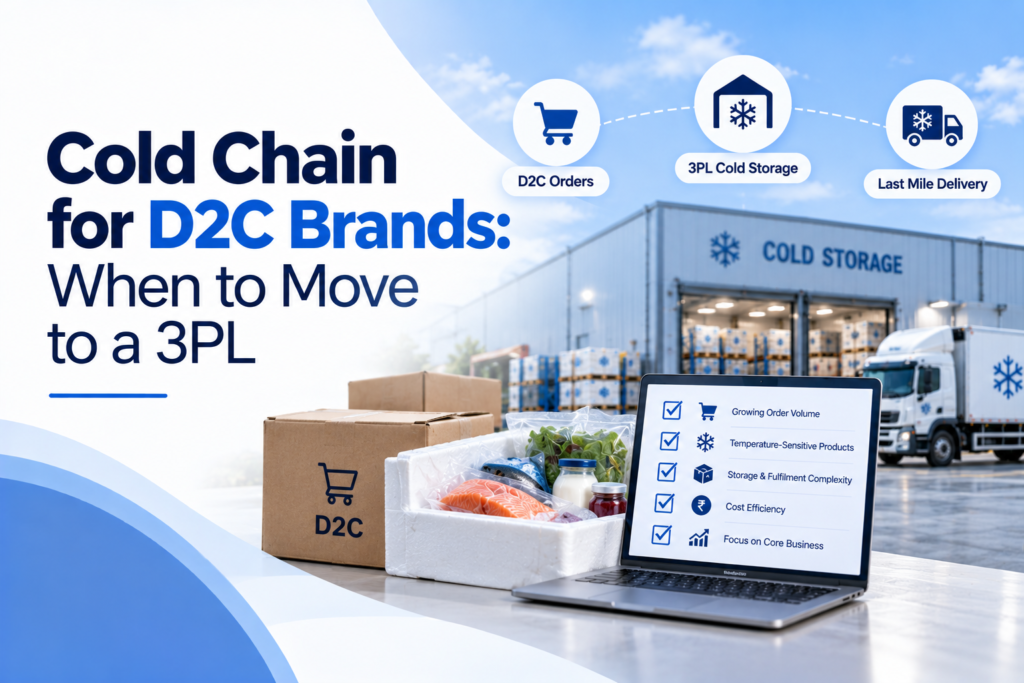
A D2C food brand should move from its own freezers to a 3PL when volume, city spread or spoilage complaints outgrow its own setup. Most D2C orders spoil at the pack and courier handover, not in storage. Fix those two points first, then decide whether storage moves.
For a founder or COO at a frozen, ice cream, meat or dairy D2C brand, the question is timing. Move too early and you carry a commitment you cannot fill. Move too late and melted boxes cost you orders.
This guide sets out a stage ladder, the points where orders fail, and the costs that change when you outsource.
| Short answer Move to 3PL storage when you cannot hold stock and pack orders to a steady standard yourself. This usually happens when volume and spoilage complaints rise together. Move to multi-city nodes only when courier transit times, not storage, cause most failures. A 3PL is too early if your volume cannot meet a minimum commitment. |
TL;DR
- D2C cold chain usually grows in three stages: own freezers, 3PL storage with courier, then multi-city nodes.
- Orders mostly fail at pick, pack and the courier leg, not in the freezer.
- Packaging and handover time decide how long a box stays cold.
- FSSAI’s 15 October 2026 advisory asks for consignment records and food-grade packaging.
- FICCI and Grant Thornton Bharat propose a machine-readable temperature record for every batch.
- One ice cream brand grew its freezer network from 3,732 to 15,490 units in a year.
- The D2C Cold Chain Stage Ladder shows the trigger for each move.
- Next step: score your brand against the ladder before you request quotes.
→ Tell Coldman your order pattern and ask which stage fits
The Three Ways D2C Brands Run Cold Chain Today
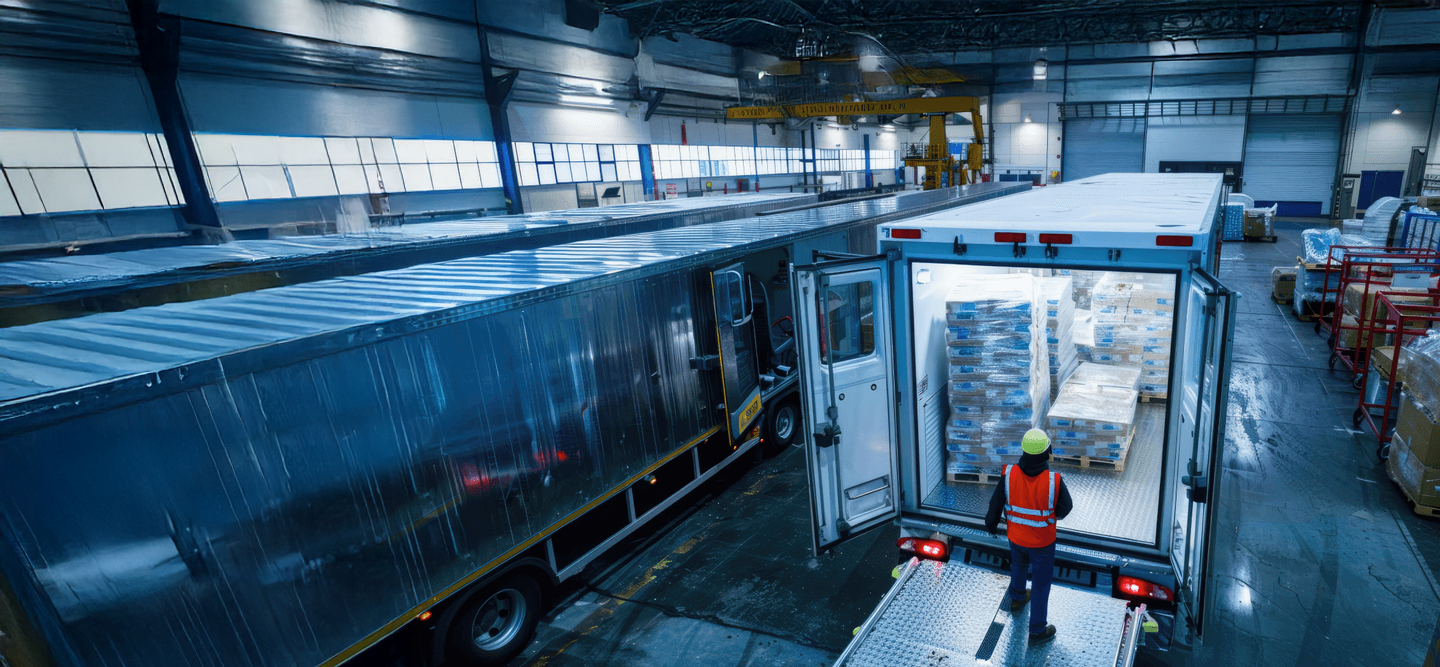
A D2C founder typically starts by packing orders from a home kitchen or a leased freezer. The second stage places stock in 3PL cold storage and uses a courier for the last mile. The third stage adds city nodes, so boxes travel shorter distances.
Each stage trades control for scale. The wrong move is skipping the second stage because the third looks impressive.
Where Orders Actually Spoil: Pick, Pack and the Courier Leg
The assumption is that storage is the weak link. The reality is that orders fail between the freezer and the doorstep. The weak points are the pack bench, the courier handover and the hours on the road.
A break at any stage can cut shelf life or ruin a consignment, FICCI and Grant Thornton Bharat note, per Business Standard. The same report estimates that 17 million to 47 million tonnes of food is lost each year across horticulture, dairy, meat, poultry and fish.
Packaging That Buys Hours
A fulfilment manager can lengthen the cold window without changing storage. Insulated boxes, gel packs or dry ice, and a pack-out that closes the box fast all help. Pack orders only when the courier is ready to collect.
FSSAI’s advisory of 15 October 2026 asks for food-grade primary packaging and suitable secondary packaging. It also asks for protection from dust, moisture and pests, reported by The New Indian Express. It also asks for records and traceability for every consignment.
The D2C Cold Chain Stage Ladder
The D2C Cold Chain Stage Ladder links each stage to the trigger that justifies the next.
| Stage | How it runs | Move up when |
| 1. Own freezer | You hold stock and pack orders yourself | Spoilage complaints rise, or packing takes over the founder’s day |
| 2. 3PL storage and courier | A cold store holds stock and packs orders; a courier delivers | Transit time, not storage, causes most failures in your main cities |
| 3. Multi-city nodes | Stock sits in several cities and ships locally | Your top cities each have steady volume that fills a node |
A COO can fill this in with last quarter’s data on complaints by city, courier and pack time. If the failures cluster on long courier routes, a node helps. If they cluster at the pack bench, a better pack-out helps first.
| 📊 Freezers at scale Krishival Foods, maker of Melt N Mellow ice cream, grew its deep freezers from 3,732 to 15,490 in the year to 31 March 2026. It reports over 30,000 retail touch points.Source: Krishival Foods press release, NSE, 20 April 2026 |
Marketplace and Quick Commerce Inbound Follow Different Rules
Selling through marketplaces or quick commerce adds handover rules from the platform. A channel head should treat each platform as a separate delivery standard, with its own receiving checks.
FICCI and Grant Thornton Bharat propose a unified standard under which every batch carries a machine-readable temperature record for its whole journey. Start that habit now. It gives buyers, platforms and regulators evidence of how your product was handled.
Costs That Change When You Outsource
Outsourcing moves cost from your own freezers and labour to storage, handling and courier lines. It adds a commitment, because 3PL storage is usually contracted for space over a term.
ICRA’s December 2023 report described Coldman’s contracts as one to three years with minimum-guarantee space reservation. Coldman should confirm current terms, and this post does not quote them. Weigh that commitment against the steady volume you can show.
Coldman’s Technology page lists e-commerce and q-commerce support, with temperature-controlled B2C supplies, a real-time delivery tracker and return management (October 2026). Its Talk to us page lists real-time stock visibility through its warehouse management system.
→ Ask Coldman how its storage and delivery tracking connect to your order system
How to Read Your Own Numbers
A COO can place the brand on the ladder with four numbers from the last quarter:
- Complaints per 100 orders, by city.
- Complaints by courier and by day of the week.
- Time from pack to courier collection.
- Share of orders delivered after the courier’s stated window.
If complaints cluster in one city or one courier, change that lane first. If they spread evenly and follow pack time, your pack-out is the problem, not your storage or your courier.
Only when storage itself is the problem, with warm stock before packing, does a 3PL fix the root cause.
Choosing Your First City Node
If your numbers point to a node, choose the city on evidence. A supply chain lead can compare three lines. They are the share of orders from that city, the failure rate on the current courier lane, and sell-through speed.
A city with steady volume and a weak courier lane is the strongest case. A city with a few orders a week is not.
Returns and Refunds: Why They Belong in the Plan
Returns are the earliest signal that your cold chain is failing. A customer experience lead should log each complaint with the city, courier, pack time and weather.
After a month, the pattern shows whether the fix is packaging, pack timing or a different courier lane. A returned frozen box is also a food safety question, so agree how returned goods are received and discarded.
What to Ask a 3PL About Pick and Pack
A fulfilment head can use these questions in every conversation:
- Can the 3PL pick and pack to your courier’s collection time?
- Which pack-out materials does it use, and can you specify yours?
- How does it record pack time and handover time?
- Which couriers does it work with in your top cities?
- How are returns received, quarantined and discarded?
Run a Pilot Before You Commit
Ask whether a pilot on one city and one product line is possible. Track complaints, spoilage and delivery time against your own freezer for the same period.
With a minimum-guarantee model, a pilot may not be possible. Test your own pack-out and courier lanes separately first, and write the start date and decision date into any agreement.
When a 3PL Is Too Early, and When Coldman Is Not the Fit
If you ship a few dozen orders a week from one city, your own freezer and a good pack-out may serve you better. A 3PL with a minimum commitment is too early at that scale.
Coldman Logistics is not the right partner for volumes too small to meet a minimum reservation. Its network page lists nine live sites, and its industries page shows the food lines it serves. Its Quality Assurance page describes round-the-clock operations.
FAQs
What are the D2C brands in India?
D2C brands sell directly to consumers through their own site, apps or marketplaces. In cold chain categories they include frozen snacks, ice cream, meat, seafood and dairy sellers.
What is meant by cold chain logistics?
Cold chain logistics is the temperature-controlled movement and storage of perishable goods from source to consumer. It covers pre-cooling, refrigerated transport, cold storage, processing, distribution and last-mile delivery.
What are the four stages of the cold chain?
Commonly they are storage, refrigerated transport, handling and distribution, and last-mile delivery. FICCI and Grant Thornton Bharat also include pre-cooling and processing at the start.
Do D2C brands need a cold storage partner?
Not at the start. A partner makes sense once your own freezers and pack-out cannot hold quality at your volume, and your volume can meet a minimum commitment.
The Cost of Moving Too Late
For a D2C founder, the cost is a melted box on a first-time customer’s doorstep, a refund, and a review that stays online.
Match your stage to your volume before the next peak.
→ Talk to the Coldman team about the right cold chain stage for your brand