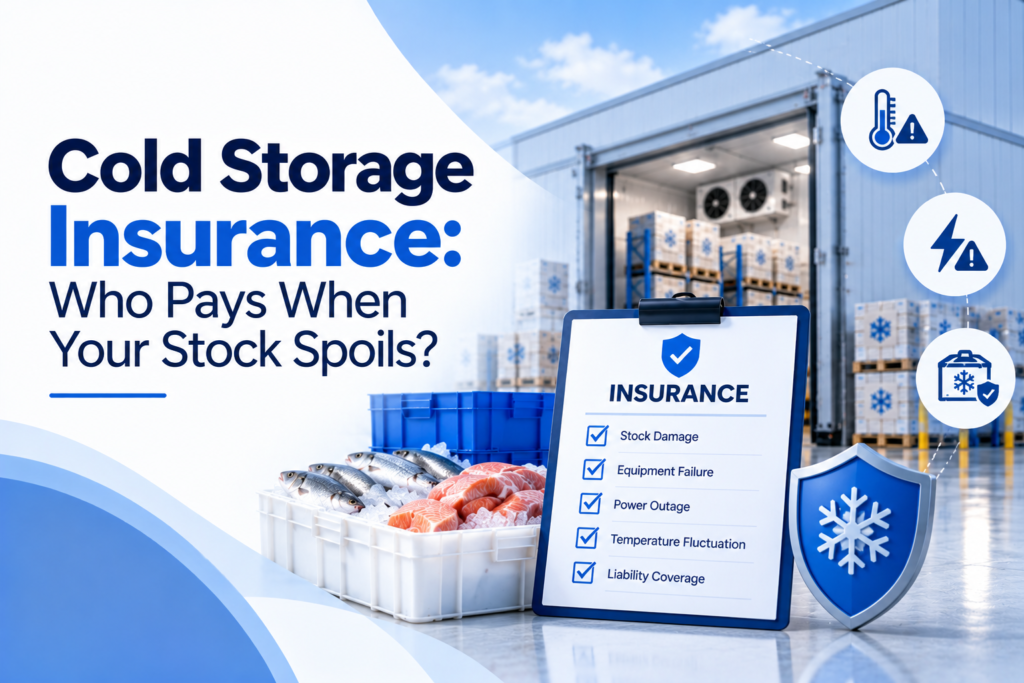
Cold storage insurance in India is usually bought by the cold store, and it covers narrow events. Under the Deterioration of Stock wording I read, a refrigeration stoppage of under 24 hours, a power failure and fire are all excluded. Your stock is protected only if you check what each party’s cover pays for.
For a CFO at a frozen or dairy brand, “the 3PL has insurance” is not an answer. This guide sets out the three layers that protect stock in a 3PL cold store. It adds a matrix of who pays for each event and the clauses to read before you sign.
| Short answer Three things protect stock in a third-party cold store: your own stock policy, the provider’s legal liability and the provider’s insurance. Do not assume the provider’s policy covers your goods. Where a provider is the insured, the wording decides what pays, and many spoilage causes are excluded. |
TL;DR
- Stock in a 3PL cold store is protected by your own cover, the provider’s legal liability and the provider’s insurance.
- A warehouse keeper is a bailee under Sections 151 and 152 of the Indian Contract Act, 1872.
- In the ICICI Lombard Deterioration of Stock wording, the insured is the cold store owner.
- That wording covers an accident to refrigeration machinery, and excludes power failure and stoppages under 24 hours.
- Fire, flood and natural catastrophe sit outside that policy and need property cover.
- Missing temperature records are the usual reason a spoilage claim fails.
- The Spoilage Responsibility Matrix shows who pays for each event.
- Next step: ask your provider for its liability limits and cover in writing.
→ Ask Coldman for its liability terms before you move stock
The Three Covers That Protect Stock in Someone Else’s Warehouse
A head of supply chain at an ice cream brand has three layers to check:
- Your own stock policy, often a fire and allied perils cover.
- The provider’s legal duty of care.
- The provider’s insurance, which usually protects the provider.
Each layer answers a different question:
- Your policy asks what you lost.
- The law asks whether the provider took care.
- The provider’s policy asks whether a listed event caused the loss.
What Indian Law Expects of a Warehouse Keeper
Under the Indian Contract Act, 1872, a warehouse keeper holding your goods is a bailee. Section 151 requires the care an ordinarily prudent person would take of their own goods. Section 152 says the bailee is not liable for loss or deterioration if that care was taken, unless a special contract says otherwise.
For a procurement head, the practical point is the special contract. Your storage agreement can widen or narrow the provider’s liability, so the clause on loss, damage and limits matters more than the statute.
Deterioration of Stock Cover: What It Pays For and What It Excludes
The ICICI Lombard Deterioration of Stock wording responds to an accident to refrigeration machinery that raises chamber temperature and causes deterioration or contamination. The wording sets conditions on how the insured accepts and stacks stock, including pre-cooling for 24 hours and set clearances around diffusers.
| 📊 Under 24 hours is excluded The wording excludes damage from stoppage of refrigeration plant for less than 24 hours following an accident. It also excludes damage from failure of electric supply for whatever reasons.Source: ICICI Lombard Deterioration of Stock Insurance prospectus |
The exclusions go further. Overloading beyond rated capacity, improper storage, poor air circulation and uneven temperature are excluded. So are rack collapse, with a narrow exception, and fire, flood and natural catastrophe.
Why Cold Store Fires Change the Insurance Question
Fire is excluded from this wording, so it needs separate property cover. Two 2026 fires show why.
Republic reported that six fire tenders attended a blaze at the Himalayan Cold Storage in Lucknow’s Chinhat area on 28 June 2026. The cause was unconfirmed.
In Los Angeles, a June 2026 fire at a Lineage cold store prompted shelter-in-place orders. Lineage said it believed the fire began during rooftop solar work, but the official cause was undetermined, Insurance Journal reported.
The Spoilage Responsibility Matrix
The Spoilage Responsibility Matrix maps each event to the cover that may respond and the evidence the claim needs. It is a checklist, not a coverage opinion.
| Event | Cover that may respond | Evidence the claim needs |
| Accident to refrigeration machinery | Provider’s Deterioration of Stock cover, if machinery cover runs alongside | Breakdown report and temperature log |
| Stoppage under 24 hours | Excluded in the wording read; check your own cover | Alarm history and chamber log |
| Power failure | Excluded in the wording read; check generator cover and your policy | Utility outage record and generator log |
| Fire | Property cover held by you or the provider | Fire report and stock register |
| Flood or natural catastrophe | Excluded in the wording read; property cover | Survey and stock register |
| Rack collapse | Excluded in the wording read, with a narrow exception | Racking inspection record |
| Temperature excursion in transit | Carrier’s liability and your transit cover | Data logger file and delivery note |
A risk or insurance lead can complete this for one chamber in an afternoon. Every row marked “check your own cover” is a gap that a loss will expose.
A 12-Hour Refrigeration Failure in a Frozen Chamber
Take a hypothetical case. A compressor fails at night in a chamber holding frozen pallets, and engineers restore cooling after 12 hours. The wording I read excludes a stoppage of under 24 hours, so a claim through that cover may fail even though the stock has thawed.
Your own policy then decides whether the loss is covered. This is why the stoppage period and time excess are the first lines to read in any cover, yours or the provider’s.
Contract Clauses to Read Before You Sign
A legal or procurement lead should look for these clauses in the storage agreement:
- A liability limit per event and in total, stated in the contract.
- Whether the provider carries Deterioration of Stock and fire cover, and for whom.
- Who must insure the stock, and whether the provider’s policy names you.
- What temperature records the provider keeps, for how long, and when you can see them.
- The notice period for reporting a loss, and who surveys it.
Coldman’s Quality Assurance page describes 24×7 operations backed by full DG power backup (October 2026). Its Technology page lists real-time monitoring of the refrigeration system and door operations. Ask for the liability limits and cover that sit behind these systems in writing, because this post does not state them.
→ Ask Coldman which events its cover and your cover each respond to
How to Read a Provider’s Insurance Certificate
A procurement head should ask for the certificate and the policy wording, not a broker’s summary. Check these lines:
- The named insured, and whether your company is named or only the provider.
- The period of insurance and the renewal date.
- The sum insured, the excess, and any time excess before cover starts.
- Whether the refrigeration machinery is insured under a machinery policy running alongside.
- The exclusions, especially power failure, short stoppages and fire.
The ICICI Lombard wording ties its cover to machinery insured under a concurrent machinery policy. If the certificate does not show one, ask why.
What a Spoilage Claim File Needs
A claim fails more often on records than on cover. For a QA head, the file should be ready before any loss:
- A temperature log for the chamber, with alarm history, covering the loss period.
- The stock register showing what was in the chamber, with batch and expiry.
- A breakdown or outage report from the provider, with times.
- Photographs and a surveyor’s report on the condition of the stock.
- The storage agreement and any insurance certificates.
The ICICI Lombard wording also sets storage conditions, such as pre-cooling for 24 hours before loading and clearances around diffusers. A claim can be questioned if those conditions were not met, so ask the provider how it records them.
Questions to Put to Your Own Insurer
A risk lead should put these questions to your own broker or insurer:
- Does my stock policy cover stock at a third party’s premises, and at named addresses?
- Does it cover spoilage from a refrigeration breakdown or power failure, and with what time excess?
- What temperature records does the insurer need, and for what period?
- Does cover continue if the provider’s own policy lapses?
Get the answers in writing and attach them to the storage agreement file.
When Coldman Is Not the Fit
If you need a provider to carry every stock risk, no cold store model delivers that. Coldman Logistics works on contracted capacity, not blanket cover. A brand that wants complete stock insurance from its provider should price that cover directly with its own insurer.
A short, one-off storage need is also better served by a local operator. Coldman’s network page lists nine live sites, and its industries page shows the food and beverage lines it serves. Its Technology page shows the records it can produce for a claim.
The Cost of Assuming Someone Else Is Covered
For a CFO, the cost is a full pallet load of stock, thawed overnight, with no policy that clearly pays. The claim then turns on temperature logs and contract wording nobody read at onboarding.
Read the cover and the contract before the first pallet moves.
→ Talk to the Coldman team about temperature records and liability terms for your stock
FAQs
What is warehouse liability insurance?
It covers a warehouse operator’s legal liability for loss or damage to goods in its care. The operator is the insured, so the cover responds to the operator’s legal duty, not to your commercial loss.
Who is responsible if goods are damaged in transit?
Responsibility depends on the carrier’s contract and on your transit cover. Agree in writing who logs temperature in the vehicle and who files the claim.
What type of insurance does a cold storage warehouse need?
A cold store typically needs property cover for fire and allied perils, machinery breakdown cover and Deterioration of Stock cover. Stock owners need their own stock cover on top.
Does the cold store’s insurance cover my stock?
Not automatically. In the wording read here, the cold store is the insured, and power failure and stoppages under 24 hours are excluded. Check what your own policy adds.