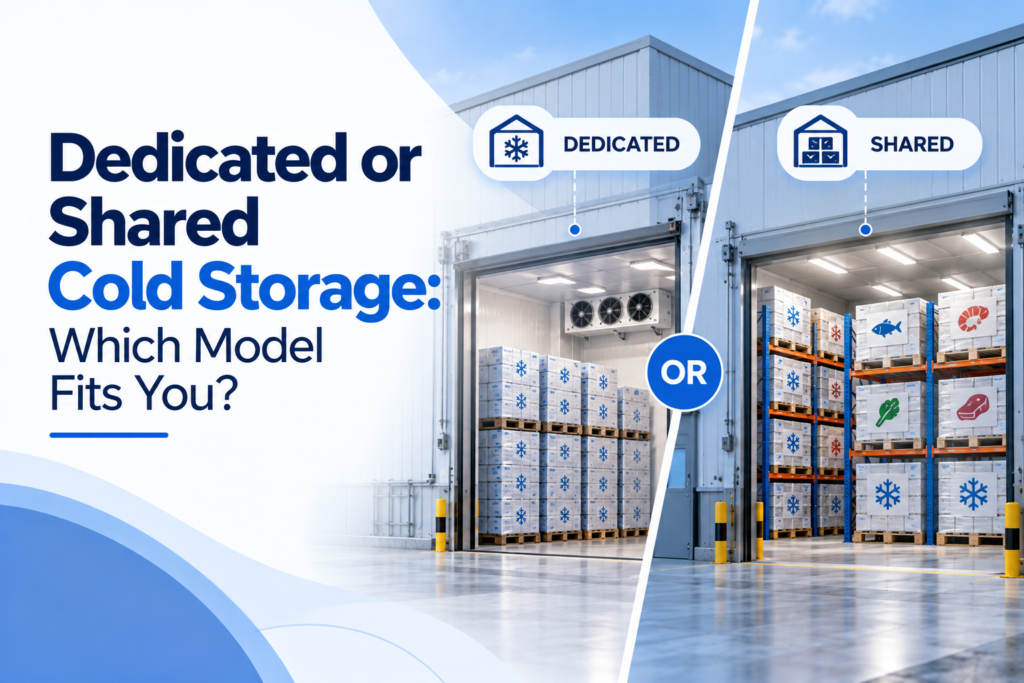
Choose shared cold storage when your volume swings and your product and audit needs are standard. Choose a dedicated chamber, or a built-to-suit site, when volume is steady and your product, audit or customer rules need tighter control. The cheaper-looking option is the wrong one if it breaks your set points or your audit scope.
For a head of supply chain at an ice cream, QSR or FMCG brand, this is a decision about utilisation and risk, not only price. This guide compares the three models, shows a grid for choosing between them, and lists the contract questions that follow.
| Short answerShared storage suits uneven volumes and standard requirements. A dedicated chamber suits steady volumes and stricter control. A built-to-suit site suits large, long-term needs. The model you pick decides door traffic, audit scope and how easily you can exit. |
TL;DR
- Shared, dedicated and built-to-suit are three different risk and commitment models.
- Shared storage pools space across clients, so door traffic and set points are shared too.
- A dedicated chamber gives control but needs steady utilisation to pay back.
- Built-to-suit fits large volumes and long terms, with the longest commitment.
- India has 40.22 million tonnes of cold storage, but about three-quarters is used for potatoes.
- FICCI and Grant Thornton Bharat say year-round utilisation contracts reduce seasonality risk.
- The Utilisation Break-even Grid links volume pattern and compliance need to a model.
- Next step: score your volume and audit needs before you request quotes.
→ Share your volume pattern and ask Coldman which model fits
The Decision: Your Own Chamber, a Shared Chamber or a Built-to-Suit Site
A COO choosing cold storage faces a commitment question before a price question. The three models place that commitment differently:
- Shared space spreads it across clients.
- A dedicated chamber puts it on you.
- A built-to-suit site puts the longest commitment on you, in return for a facility designed around your product.
India’s supply picture shapes the options. India had 40.22 million tonnes of capacity, about 84% of the 2037-38 requirement, per a FICCI and Grant Thornton Bharat report covered by Business Standard. Roughly three-quarters is used for potatoes, so branded-goods capacity is a smaller pool than the headline suggests.
What Changes Between the Models
The table compares the three models on the dimensions that decide risk and cost. It carries no prices, because quotes vary by site and contract.
| Dimension | Shared chamber | Dedicated chamber | Built-to-suit site |
| Commitment | Lowest, usually by space reserved | Medium, tied to chamber size | Longest, tied to the build |
| Control of set points | Shared with other clients | Yours within the site’s limits | Designed around your product |
| Door traffic | Other clients’ movements | Your own movements | Your own movements |
| Audit scope | The provider’s, shared | Chamber-specific records possible | Your specification |
| Scalability | Flexible within the site | Needs a larger chamber | Needs expansion planning |
| Exit | Easiest | Harder | Hardest |
A procurement head should add a column for the contract’s exit terms. Exit is where the real cost of a model shows up.
Chamber Conflicts Nobody Mentions: Door Traffic, Odour and Set Points
In a shared chamber, other clients’ door openings affect your temperature. A frozen dessert next to a strongly smelling product can pick up odour. Allergen separation and set-point conflicts add a third risk.
For a QA head at a bakery or ice cream brand, these are audit findings waiting to happen. Dedicated chambers remove the conflict, while shared chambers need clear segregation rules from the provider.
Shared Is Not the Cheap Option, Dedicated Is Not the Premium One
The assumption is that shared storage is the economy choice. The reality is that utilisation decides the economics. A half-empty dedicated chamber is expensive, and a shared chamber with a minimum space reservation is still a commitment.
FICCI and Grant Thornton Bharat make a related point about cold chain assets. They say year-round utilisation contracts and multi-commodity facilities can reduce the seasonality risk that makes some assets hard to finance. For a brand, the lesson is to match commitment to steady volume.
The Utilisation Break-even Grid
The Utilisation Break-even Grid links two questions to a model. How steady is your volume across the year? How strict are your compliance and customer requirements?
| Standard requirements | Strict requirements | |
| Steady volume | Dedicated chamber in a multi-client site | Dedicated chamber or built-to-suit site |
| Seasonal or uneven volume | Shared chamber | Small dedicated chamber with flexible space |
A supply chain manager at an ice cream brand has seasonal peaks and usually strict chamber needs. That points to a small dedicated chamber with flexible space, not a full-year large commitment. Pharma needs its own checks on top of this grid.
| 💡 Tip for supply chain teams Plot your pallet positions by month for the last two years. Size committed space near your lowest steady month, and treat the rest as flexible space. |
How Contracts Differ Between the Models
ICRA’s December 2023 rating report described Coldman’s model as one to three year contracts with minimum-guarantee space reservation, alongside a growing built-to-suit model. Coldman should confirm current terms, and this post does not quote them. Ask any provider about the term, the reserved space, the handling charges and the exit route.
Coldman’s Quality Assurance page lists exclusive pharma zones and multi-commodity storage (October 2026). That shows the site can separate product classes. Ask which chambers are dedicated and which are shared at your site.
→ Ask Coldman which chambers at its sites are dedicated and which are shared
A Worked Example: An Ice Cream Brand’s Year
Take a hypothetical ice cream brand. Volume is low from October to January and climbs from February, as frozen dessert demand typically does before summer.
A dedicated chamber sized for the peak sits half empty for four months. A shared reservation sized for the base load, plus a small dedicated chamber for the strictest SKUs, matches the year better.
The brand’s head of supply chain can then review the split at each renewal. If the dedicated share fills all year, it is time to size up.
Contract Mechanics That Differ Across the Three Models
A legal or procurement lead should compare five mechanics in every quote:
- Reserved space: how much is committed, and what happens to unused positions.
- Term and lock-in: how long, and what exit or step-down options exist.
- Handling charges: whether in-and-out handling is separate from storage.
- Expansion: whether more space is available at the same site, and on what terms.
- Shared-site rules: segregation, door discipline and audit access.
Shared and dedicated models differ most on the first and last of these. Built-to-suit differs on term and expansion, because the facility is designed around you.
A Scoring Sheet for Your Next RFQ
Use this sheet when you request quotes. Score each line from one to three, where three means the line applies strongly to you.
| Criterion | What a 3 looks like |
| Steady volume | Your lowest month is close to your peak |
| Strict rules | Customers or auditors need chamber-level records |
| Sensitivity | Your product is exposed to odour, allergens or door traffic |
| Growth | You expect to need more room at this site |
| Commitment | You can fill reserved space in your lowest month |
Mostly ones point to shared space. Mostly threes point to a dedicated chamber or a built-to-suit site.
Pharma and Ice Cream: Where Shared Chambers Break Down
Shared chambers work until a product’s rules tighten. A pharma QA head needs chamber-specific temperature records and audit access, which a shared chamber can restrict.
An ice cream brand needs stable deep-freeze set points. Busy shared doors disturb them. Both cases point towards a dedicated chamber, even at modest volumes.
The Grading Framework Will Change How You Compare Sites
In late September 2026, DPIIT’s Joint Secretary said the government is building a grading and rating framework for warehouses and cold chains. It is working with the Asian Development Bank.
Maritime Gateway reported that it is still in development. Whether ratings will be regulated by a government body or by industry is undecided.
A procurement head should not wait for it. Compare sites today on design, fire safety, racking and records, the areas DPIIT’s recent standards cover.
When Shared Storage Is Right, and When Coldman Is Not the Fit
Shared storage is the right call for new brands, uneven volumes and standard requirements. It lets you test a market without a large commitment.
Coldman Logistics is not the right choice if your volume is too small to meet a minimum commitment. Its network page lists nine live sites, and its industries page shows the food and beverage lines it serves. Its Technology page describes the monitoring that supports each chamber.
The Cost of Choosing the Wrong Model
For a COO, the cost is a commitment that does not match your volume. The other risk is a shared chamber that fails an audit because of someone else’s cargo.
Choose the model on your volume pattern and your audit scope, not on the first quote.
→ Talk to the Coldman team about the cold storage model that fits your volumes
FAQs
What are the four types of warehousing?
Common classifications are private, public, bonded and cooperative warehouses. Cold storage buyers usually compare shared, dedicated and built-to-suit models instead.
Is distribution the same as warehousing?
No. Warehousing holds stock, while distribution moves it to customers. A cold chain provider may offer both, with temperature monitoring across each movement.
What is 1PL, 2PL, 3PL and 4PL in logistics?
A 1PL is a company moving its own goods, a 2PL is a carrier, and a 3PL runs warehousing and distribution for clients. A 4PL manages several providers for a client.
Is a dedicated warehouse more expensive than a shared one?
Not always. Utilisation decides it. A steady, full dedicated chamber can cost less per pallet than space reserved in a shared chamber that sits half empty.