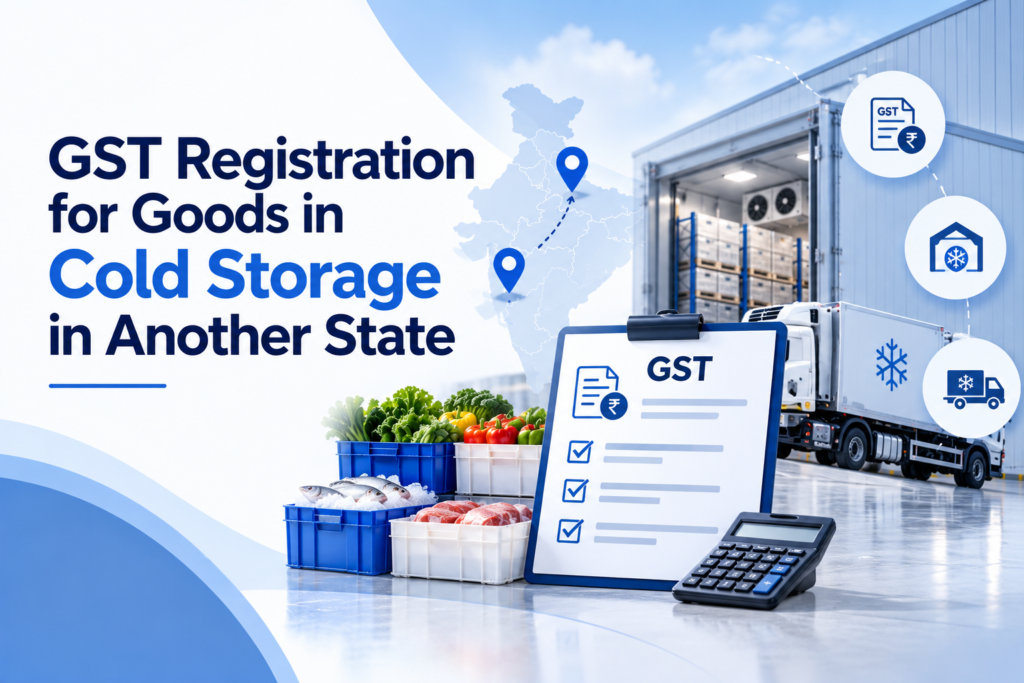
A brand registered in one state may need a second GST registration if it keeps stock in a third-party cold store in another state. CBIC’s letter of 25 September 2025 says so for a Delhi business storing goods in Haryana, when its supplies leave from that location.
For a finance controller at a Delhi-NCR food brand using a cold store in Haryana, this is a tax decision, not a storage detail. This guide explains what CBIC said, gives a four-question test, and lists what to ask your cold storage provider. It is not tax advice, so confirm the position with your chartered accountant.
| GST registration for goods stored in another state (definition) Under the CGST Act, a warehouse or cold store can count as a place of business if supplies are made from it. CBIC’s letter of 25 September 2025 says third-party operation of the cold store does not change this when supplies originate from that location. |
TL;DR
- CBIC’s letter of 25 September 2025 answers a Delhi business storing goods in a third-party cold store in Haryana.
- If supplies originate from the Haryana cold store, the business must register in Haryana.
- The test is where supplies leave from, not who owns or runs the cold store.
- Moving stock from Delhi to Haryana is a supply between distinct persons, so it needs a tax invoice and an e-way bill.
- Sales from Haryana to Haryana customers attract CGST and SGST. Sales to other states attract IGST.
- A four-question test shows whether your storage choice triggers a registration.
- Next step: put the tax question in your cold storage checklist before you sign.
→ Check your cold storage choice against your GST plan with Coldman
What CBIC Said in September 2025 About Goods in Another State’s Cold Storage
The letter is File No. CBIC-20016/75/2025-GST/1025, dated 25 September 2025. A Director (GST) in CBIC’s Policy Wing wrote it to the Principal Chief Commissioner of the CGST Delhi Zone, as reproduced by Taxguru.
It answers a representation from the Kirana Committee, Delhi, dated 28 February 2025.
The question was simple. Must a business based in Delhi register in Haryana when it supplies goods from third-party cold storage there? The answer was yes, because the cold store effectively works as a place of business for outward taxable supplies.
| “does not alter the legal position if the supply originates from that location”– CBIC Policy Wing, letter F. No. CBIC-20016/75/2025-GST/1025, 25 September 2025, on third-party operation of the cold storeSource: Taxguru, reproducing the letter |
The letter relies on Section 22 and Section 2(85) of the CGST Act. Section 2(85) defines a place of business to include a warehouse or godown. Section 22 requires registration in the state from which taxable supplies are made once turnover crosses the threshold.
When a Cold Store Becomes Your Place of Business, and When It Does Not
The trigger in the letter is that supply originates from the cold store. A head of supply chain at a frozen snacks brand who dispatches orders to Haryana customers straight from a Haryana cold store meets that trigger. A brand that only parks surplus stock there, and ships everything from its Delhi site, is in a different position.
That second case is not settled by the letter, and it is where finance and logistics teams disagree most. Ask your CA to review your dispatch flow in writing before you rely on either reading.
The threshold matters too. CBIC’s own update on GST states a threshold of ₹40 lakh of aggregate turnover for suppliers of goods.
It is ₹20 lakh in a list of special-category states, from 1 April 2019. Check the current notification for your state.
Storage Is a Tax Decision Too: Why Location Cannot Wait for Finance
The assumption is that a cold store location is a logistics choice and tax follows later. The reality is that the location can decide where you must register, which returns you file and which records you keep.
For a CFO at a dairy or ice cream brand, that changes the order of work. Finance should see the shortlist of cold stores before operations signs a contract, not after the first dispatch.
Section 35 of the CGST Act and Rule 56 of the CGST Rules, both cited in the letter, require records at each place of business. A second state means a second set of stock records and returns.
Registration or Stock Transfer: What Changes on Your Invoices
Once you register in the second state, your Delhi and Haryana establishments are treated as distinct persons under Section 25(4). Moving stock between them is a supply, not a simple transfer.
| Movement | Tax treatment per the CBIC letter | Document |
| Delhi to Haryana cold store | Supply between distinct persons, tax applies | Tax invoice and e-way bill |
| Haryana cold store to Haryana customer | Intra-state: CGST and SGST | Tax invoice |
| Haryana cold store to customer in another state | Inter-state: IGST | Tax invoice and e-way bill |
| Return from Haryana to Delhi | Same documents as the outward move | Tax invoice and e-way bill |
For an accounts executive, the practical effect is more invoices, more state-wise ledgers and a clear stock register at the cold store. The place of supply for goods follows Section 10(1)(a) of the IGST Act, which fixes it where the movement ends.
The Four-Question Registration Test
Use this test on any cold store you are considering. It turns the letter into a checklist your finance and logistics teams can answer together.
- Will customers receive goods dispatched directly from this cold store?
- Is the cold store in a different state from your registered place of business?
- Does your aggregate turnover exceed the registration threshold?
- Will you raise invoices that show this location as the origin of supply?
A yes to questions 1 and 2, above the threshold, is the case the letter covers. Take it to your CA before the first dispatch.
| 💡 Tip for finance teams Ask logistics for a one-page dispatch map of each product line. It shows in minutes which states your stock leaves from. |
What to Keep at Each Place of Business
The record duty under Section 35 and Rule 56 is practical, not abstract. For an accounts lead, it means a state-wise set of documents for every cold store location.
Keep these at each site:
- A stock register by SKU and batch, matched to the provider’s statement.
- Inward and outward notes for every movement.
- Tax invoices and e-way bills for stock transfers and sales.
- Returns and credit notes for goods sent back.
- A dispatch log showing which customers each shipment served.
A finance controller should check that the provider’s system can produce these on request. Missing records are the usual reason a simple registration question becomes a long reconciliation.
What to Ask Your Cold Storage Provider Before You Sign
A procurement head can add four questions to the standard cold storage checklist:
- Which state is the facility in, and will our dispatches originate there?
- Which stock and dispatch records does the facility issue, and in what format?
- Can the provider support invoicing and dispatch for our customers in that state?
- Who holds the stock record that matches our books at month end?
Coldman’s Talk to us page describes distribution and CFA operations that cover receiving, storage, order processing, invoicing and dispatch (October 2026). It also lists real-time stock visibility through its warehouse management system.
Its Quality Assurance page adds automated alerts and inventory ageing reports. Ask which of these documents each site can issue for your registration.
→ Ask Coldman which stock and dispatch records its sites issue for GST filings
When This Does Not Apply, and When Coldman Is Not the Fit
If you sell only within one state, or your turnover is below the threshold, the registration question may not arise. Products that move through a single warehouse in your home state raise no second-state issue.
Coldman Logistics may not suit a brand that needs a cold store for a few weeks in one state. Coldman works on contracted capacity for steady volumes, and its network page lists nine live sites, including Kundli.
Its Technology page describes the stock visibility finance teams use for reconciliation. The industries page shows the food and beverage lines it serves.
India had 8,815 cold storage facilities as of June 2025, per a FICCI and Grant Thornton Bharat report covered by Business Standard. Their combined capacity was 40.22 million tonnes. Any brand storing across state lines can meet this question.
The Cost of Finding Out After the Notice
For a CFO, the cost of missing this is not the registration itself. It is back-dated tax, interest and a reconstruction of months of invoices across two states.
Ask the question before the first pallet moves.
→ Talk to the Coldman team about stock records that support your GST filings
FAQ
Which GST is applicable to other-state supply?
Per the CBIC letter, supplies from a Haryana cold store to customers in other states are inter-state and attract IGST. Supplies to Haryana customers attract CGST and SGST.
How do you identify the place of supply?
For goods that move, Section 10(1)(a) of the IGST Act fixes the place of supply where the movement ends. Your CA should confirm how this applies to each of your dispatch routes.
Is GST registration mandatory if the cold store only stores goods?
The CBIC letter ties registration to supplies originating from the cold store. Where stock is only stored and every sale ships from your home state, take written advice from your CA before deciding.
Can a company have two GST numbers in the same state?
A person can hold registrations in several states under one PAN. Within one state, a second registration is allowed only in specific cases such as separate business verticals, so check with your CA first.