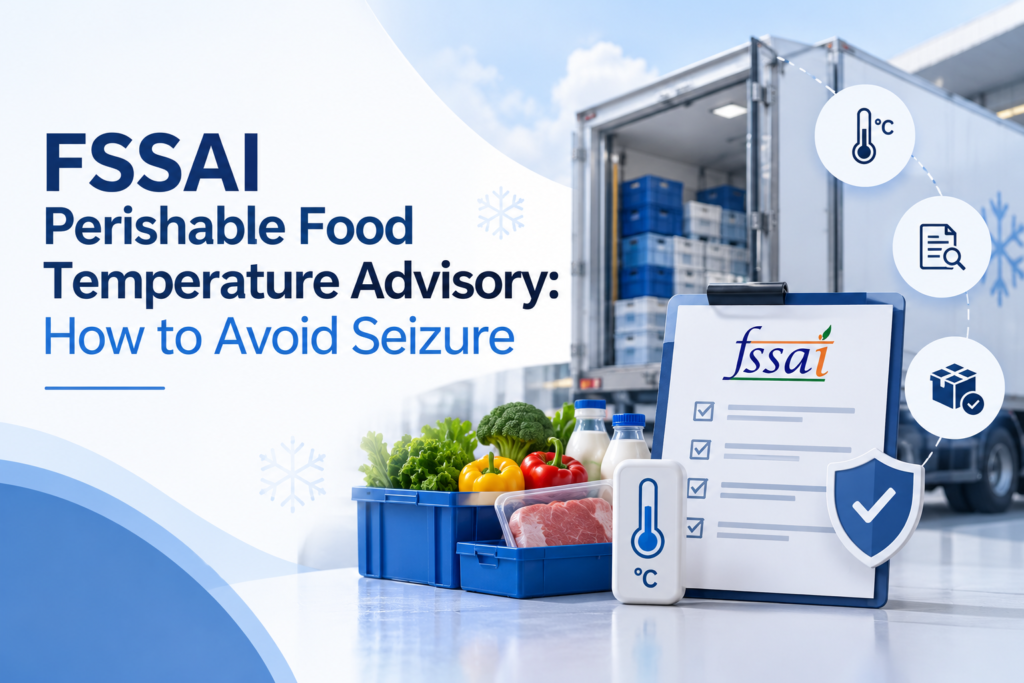
FSSAI’s advisory of 15 October 2026 tells businesses handling khoya, paneer, meat or fish to hold them at prescribed temperatures, from sourcing to the consumer. Food Safety Officers can seize and destroy stock that breaks the chain.
For a QA head at a mithai brand shipping khoya before Diwali, the FSSAI advisory on temperature control changes one thing. Officers are now told to check temperature and records in transit, not only at the premises.
| FSSAI advisory on temperature control of perishable food (definition) An FSSAI advisory, dated 15 October 2026, directing food businesses to store, move and sell khoya, paneer, meat, fish and similar perishables under controlled temperature. It rests on the licence conditions in Schedule 4 of the 2011 Licensing and Registration Regulations. |
TL;DR
- The advisory covers khoya, paneer, meat, fish and other perishables, from sourcing to the consumer.
- It adds no new rule. It enforces Schedule 4 licence conditions that already apply.
- Officers, Indian Railways and FSSAI regional offices are told to check during inspections and transport.
- Non-compliance can lead to seizure and destruction of the food.
- Telangana suspended the licences of four Hyderabad dark stores on 30 September 2026.
- The Seven-Checkpoint Chain Audit shows the evidence to hold at each handover.
- Next step: check vehicles, packaging and temperature records before the festive peak.
→ Check your festive-season storage and transport plan with Coldman
What FSSAI’s 15 October Advisory Asks Every Food Business to Do
FSSAI shared the advisory on 18 October 2026, as reported by The New Indian Express. A plant head at a paneer maker should read it as six instructions:
- Keep the prescribed temperature through chilling, storage, transport and distribution, up to the consumer.
- Move perishables only in clean, covered, hygienic vehicles suited to food.
- Use food-grade primary packaging and suitable secondary packaging.
- Stop using gunny bags and other non-food-grade coverings.
- Protect products from dust, moisture, pests, damage and cross-contamination during loading, unloading and transit.
- Keep records and traceability for every consignment, and produce them when an officer asks.
State Commissioners of Food Safety, Indian Railways and FSSAI’s regional directors are asked to keep strict vigilance during transport checks.
Not a New Rule: Why This Advisory Changes Enforcement, Not the Law
The assumption is that FSSAI has created a new cold chain rule. The reality is that Schedule 4 already makes temperature control a licence condition. What is new is where officers will look.
| “Subjecting these food products to temperature abuse may adversely affect food safety and public health.”– Dr Amit Sharma, Executive Director (Compliance Strategy), FSSAI, in the advisory of 15 October 2026Source: The New Indian Express |
For a supply chain head at a frozen fish distributor, the risk moves from the factory gate to the truck. A plant can pass every premises inspection and still lose a consignment on the road.
Who Is Exposed This Festive Season
For the operations head at each business the advisory names, the risk point differs:
- Mithai and dairy brands: open vehicles and short runs with no temperature log.
- Meat and fish processors: ice-packed loads in non-reefer vehicles, and mixed raw and processed loads.
- Cold stores and 3PL warehouses: dock dwell time and missing receiving records.
- Transporters and rail parcel consignors: no calibrated device, no trip log, no breakdown plan.
- Quick-commerce sellers: already under scrutiny. TG SAFE suspended the FSSAI licences of four Hyderabad dark stores, The Hindu reported.
The Temperature and Record Rules an Officer Will Apply
For a QA head at a frozen seafood brand, these are the lines in FSSAI’s Licensing Regulations compendium that the advisory points back to.
| Requirement | Schedule 4, Part II | Evidence to hold |
| Potentially high-risk food received at or below 5 °C | Clause 5.1.7 | Receiving temperature log |
| Frozen food received at -18 °C or below | Clause 5.1.8 | Receiving log and reefer printout |
| Raw meat, poultry and seafood stored apart from processed products | Clause 5.2.4 | Chamber allocation record |
| Transport holds the temperature and humidity the food needs | Clause 5.5.2 | Data logger file for each trip |
| Vehicles cleaned between loads of fish, meat, poultry or eggs | Clause 5.5.3 | Cleaning record per trip |
| Records kept one year or the shelf life, whichever is more | Clause 8.2 | Retained record set |
What a Food Safety Officer Checks on Your Vehicle
FSSAI’s own transport audit checklist scores a vehicle on 23 questions worth 58 points. Failing any one of its five starred questions means non-compliance, whatever the total.
- The vehicle is covered, with an intact interior and no rust or flaking paint.
- Chilled products move at 5 °C or below and frozen at -18 °C or below, with logs.
- Bulk liquid, granular or powder food moves in containers marked “for foodstuffs only”.
- A pest control programme runs, with records.
- Documentation and records are available and retained.
The checklist also asks for calibrated temperature devices and a prompt replacement vehicle if the cooling unit fails. A distribution manager at a frozen dessert brand should get both in writing from the transporter.
| ⚠️ Warning An ice-packed load in an uninsulated vehicle has no temperature log to show. Under the checklist, that alone fails a starred question. |
Coldman’s Talk to us page lists GPS-enabled temperature monitoring during all movements, with automated alerts (October 2026). That is the record the second starred question asks for.
→ Ask Coldman how its temperature records would answer an officer’s request
The Seven-Checkpoint Chain Audit
The Seven-Checkpoint Chain Audit follows one consignment through every stage the advisory names and asks for one piece of evidence at each.
| Checkpoint | What breaks | Evidence an officer can ask for |
| 1. Sourcing | Milk, meat or fish received warm | Receiving temperature record |
| 2. Chilling or freezing | Loaded before reaching set point | Chilling or blast-freezing log |
| 3. Storage | Chamber drift, a door left open | Chamber log and alarm history |
| 4. Loading | Pallets wait on an open dock | Dock time and loading temperature |
| 5. Transit | Cooling unit off or set wrong | Trip data logger file |
| 6. Transfer | Dwell at a hub or rail parcel office | Handover time and temperature |
| 7. Retail handover | Left outside the chiller | Delivery note with time and temperature |
A plant manager at a khoya maker can run this on one consignment in a morning. Any checkpoint without evidence is where the seizure risk sits.
Coldman Logistics lists door-operation monitoring and high-speed roll-up doors to limit temperature loss on its Technology page (October 2026). Those speak to checkpoints 3 and 4.
What to Do Before the Festive Peak
A COO at a dairy or meat brand can close the biggest gaps within a week:
- List last month’s trips with no temperature file.
- Replace gunny bags and non-food-grade covers on every route.
- Ask each transporter for its FSSAI licence, calibration certificates and breakdown plan.
- Set a receiving-temperature check at every depot, with a reject rule.
- Keep a consignment file ready: invoice, temperature record and route.
| 📊 100 sweet units inspected in one day Karnataka’s food safety wing inspected 100 sweet units on day three of its festive drive, took 113 samples and issued 15 notices. Source: The Hindu, 17 October 2026 |
What the Advisory Does Not Change, and When Coldman Is Not the Fit
The advisory sets no new temperature limits and no new licence category. It does not add vehicles either. Refrigerated vehicles stand at about 3.8% of the requirement for 2037-38, per a FICCI and Grant Thornton Bharat report covered by Business Standard. For a head of logistics at a frozen food brand, that means booking reefer capacity early.
Coldman Logistics is not the right partner for every festive problem. A few crates across town, a city with no site on Coldman’s network, or a one-week overflow suit a local reefer operator better. Coldman works on contracted capacity for steady volumes in the industries it serves. Its Quality Assurance page shows how its sites are run.
The Cost of Waiting Until After Diwali
For a founder of a mithai or dairy brand, the cost of ignoring this advisory is not a warning letter. It is stock seized and destroyed in the busiest selling weeks. At worst it is a suspended licence: the four Hyderabad dark stores were ordered to stop operating immediately.
Check the chain now, before the festive peak tests it.
→ Talk to the Coldman team about temperature-logged storage and distribution
FAQ
What temperature should you store perishable food at?
FSSAI’s licence conditions set receiving temperatures of 5 °C or below for potentially high-risk chilled food and -18 °C or below for frozen food. FSSAI’s vehicle checklist applies the same limits in transport.
What is the best way to transport perishable goods?
Use a clean, covered vehicle that can hold the required temperature and lets it be read from outside. Pack in food-grade material, keep raw and processed loads apart, and log temperature for the whole trip.
What are the guidelines for cold storage?
Under Schedule 4, cold storage must suit the food type and keep raw meat, poultry and seafood apart from processed products. Records are kept for one year or the shelf life, whichever is longer.
Who is responsible if the goods are damaged in transit?
The advisory applies to every food business in the chain, including transporters, who need their own FSSAI licence. Liability between a brand and its transporter depends on their contract and insurance, so agree in writing who logs temperature.