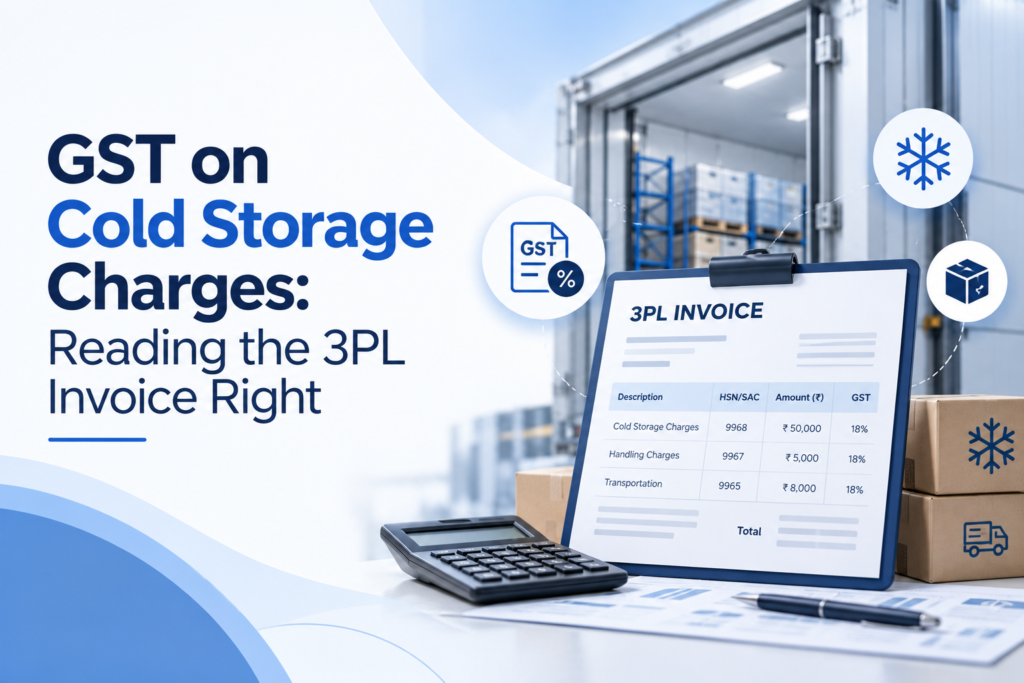
A cold storage invoice usually carries more than one tax treatment. Storing unprocessed agricultural produce is nil-rated under Entry 54(e) of Notification 12/2017, while storage of other goods and rented premises are reported at 18%. TDS then depends on whether the payment is for work or for rent.
For an accounts executive at a frozen food or dairy brand, the 3PL invoice is where these rules first meet your books. This guide shows what to check on each line, and where to take written advice from your chartered accountant. It is not tax advice.
| GST on cold storage charges (definition) GST on cold storage charges is the tax on a provider’s storage, handling and related services. Storage and warehousing of agricultural produce is nil-rated, while storage of other goods and rental of cold storage space are taxed. The treatment depends on what is stored and what the provider does. |
TL;DR
- Storage of agricultural produce is exempt under Entry 54(e) of Notification 12/2017-CT(R).
- Processed items such as tea, coffee, jaggery and dal are not agricultural produce, per CBIC Circular 16/16/2017.
- Rulings and commentary cite 18% for storage of other goods and for renting cold storage space.
- From 1 April 2026, contractor TDS sits in Section 393(1) of the Income-tax Act, 2025.
- Whether a payment is work or rent decides the TDS entry, so split mixed invoices.
- A line-by-line invoice map shows what to verify and what record to keep.
- Next step: ask your provider for an itemised sample invoice.
→ Ask Coldman for an itemised sample invoice before you sign
Why a Cold Storage Invoice Is Not One Tax Line
A finance controller at a snacks brand sees one number on the invoice. The provider sees several services: space, handling in and out, blast freezing, repacking and transport. Each can be taxed differently.
Coldman’s Talk to us page lists blast freezing and tempering, repacking, labeling, sorting, grading, palletization and kitting (October 2026). Each of these would be a separate line on a detailed invoice.
GST on Cold Storage Charges: Exempt Produce vs Taxable Goods
The exemption belongs to the goods stored, not to the cold store. Read the table against your own product list.
| What is stored or provided | Treatment to verify | Basis |
| Unprocessed agricultural produce | Storage or warehousing is nil-rated | Entry 54(e), Notification 12/2017-CT(R) |
| Tea, coffee, jaggery, dal | Processed, so not agricultural produce | CBIC Circular 16/16/2017-GST |
| Processed foods and pharmaceuticals | Storage reported at 18% | Commentary on Notification 11/2017 |
| Cold space rented without handling the goods | Renting of immovable property, 18% | Advance ruling reported by Taxscan |
The Telangana Authority for Advance Ruling in the Gubba Cold Storage case held that Entry 54(e) applies to storage for both farmers and traders. CBIC’s circular shows how processing decides whether a product still counts as agricultural produce. Verify each row against the current notification text.
The Exemption Belongs to the Goods, Not the Cold Store
The assumption is that a cold store charges no GST because it stores food. The reality is that the exemption follows the goods.
For a procurement head at a brand with frozen snacks, packed dairy desserts or ready meals, those products are processed. A frozen vegetable or a chilled fruit may raise the question the circular answers: has processing changed the essential characteristics of the produce? Settle that with your CA before you assume a nil rate.
India’s cold storage network leans heavily towards exempt produce. About three-quarters of the 40.22 million tonnes of capacity is used for potatoes, per a FICCI and Grant Thornton Bharat report covered by Business Standard. Many cold stores therefore invoice mostly nil-rated storage, and a branded-goods provider will not.
TDS on Cold Storage Charges: Work or Rent?
From 1 April 2026, the Income-tax Act, 2025 replaced the old Act. Contractor payments that were under Section 194C now sit in Section 393(1), item 6(i).
For an accounts payable lead, the rates reported for item 6(i) are 1% for individual or HUF payees and 2% for others. The reported thresholds are ₹30,000 for a single payment and ₹1,00,000 in a year, per Taxheal’s summary. Check the Act’s text before you set your deduction master.
The harder question is the nature of the payment. Where the provider handles, picks and dispatches your goods, the payment looks like work under a contract.
Where you pay only for space, it may look like rent, which the Act treats under a separate provision. Mixed invoices need a clear split.
| ⚠️ Warning One lump-sum line for “storage and services” forces you to pick a single TDS treatment for everything. Ask for the invoice to separate space from handling. |
The Line-by-Line Invoice Map
The Line-by-Line Invoice Map turns a cold storage invoice into a checklist. Use it with your CA when you onboard a provider.
| Invoice line | GST to verify | TDS view to settle | Record to keep |
| Storage per pallet or chamber | Goods stored: produce or processed | Space only, or space with services | Stock register and product list |
| Handling in and out | Service to the goods owner | Work under contract | Inward and outward notes |
| Blast freezing | Processing service | Work under contract | Freezing batch log |
| Repacking and kitting | Service on your goods | Work under contract | Job sheet per batch |
| Transport | Transport rules apply separately | Work under contract | Consignment note and e-way bill |
| Reporting and WMS access | Service bundled or separate | Follow the main service | Contract schedule |
A finance controller can fill this in for one month’s invoice in an hour. Any line that needs “verify” in two columns is where a notice is most likely to arrive.
Questions to Settle With Your Provider Before the First Bill
A procurement head can add these to the vendor onboarding checklist:
- Will the invoice separate space, handling, blast freezing, repacking and transport?
- Which SAC code and GST treatment does the provider apply to each line?
- Does the contract describe the payment as rent, as a service, or a mix?
- Which stock register supports the invoice at month end?
Coldman’s Technology page describes real-time inventory through a mobile app and web portal, with automated alerts for transactions and reports (October 2026). Ask how those reports map to your invoice lines.
→ Ask Coldman how its invoices separate space, handling and value-added services
When This Does Not Apply, and When Coldman Is Not the Fit
If you store only unprocessed produce in bulk, the nil-rate exemption may cover your whole bill. A trader holding potatoes or onions in a regional bulk cold store is in that position. Such a store may suit you better than a 3PL.
Coldman Logistics is also not the right choice for a short, one-off storage need. Its Quality Assurance page describes round-the-clock operations, and Coldman works on contracted capacity for steady volumes. Its industries page lists the food and beverage lines it serves, and its network page lists nine live sites.
The Cost of an Unchecked Invoice
For a CFO, the cost of an unchecked invoice is not the tax rate. It is a disputed credit, a short deduction found at year end, and a reconstruction of twelve months of bills.
Check the first invoice line by line, not the twelfth.
→ Talk to the Coldman team about itemised invoicing for storage and distribution
FAQs
Is 12% GST still applicable on cold storage?
Rulings and commentary on taxable cold storage cite 18%. Check the current CBIC rate notification for your service before relying on an older figure.
What is the HSN code for cold storage charges?
Services carry SAC codes, not HSN codes. Commentary cites SAC 9967 for storage of non-agricultural goods, and an Andhra Pradesh ruling placed agricultural storage under SAC 9986. Confirm the code with your provider and CA.
Is TDS applicable on cold storage charges?
It can be. Payments for work under a contract fall under Section 393(1) item 6(i) from 1 April 2026, subject to thresholds. Pure rent for space is treated under a separate provision.
Is storage of agricultural produce exempt from GST?
Yes, storage and warehousing of agricultural produce is nil-rated under Entry 54(e). Processed goods such as tea, coffee, jaggery and dal do not count as agricultural produce under CBIC Circular 16/16/2017.