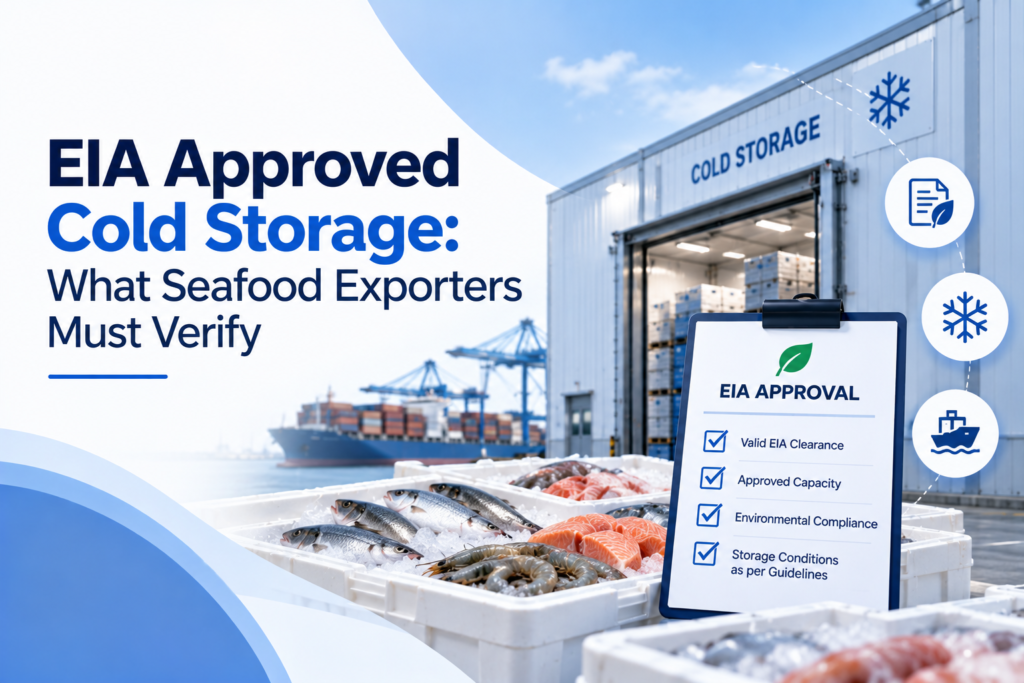
For seafood export, “EIA approved cold storage” means a cold store approved within the Export Inspection Council system, with its own number and category. Independent cold stores storing frozen fish of approved establishments have their own requirements, application and assessment. Verify the approval before export stock moves in, not at the port.
For an export manager at a seafood processor or merchant exporter, a cold store without the right approval is a risk to the consignment. This guide explains who approves what, the requirements an assessor checks, and a five-minute verification you can run on any cold store.
| EIA approved cold storage (definition) An EIA approved cold storage is approved under the Export Inspection Council’s executive instructions to store frozen fish and fishery products of approved establishments. The Export Inspection Council acts as competent authority for EU establishments and the Export Inspection Agencies for non-EU establishments. |
TL;DR
- Frozen fish for export must sit in a unit that holds the right EIC or EIA approval.
- Independent cold stores have their own approval route, application and assessment report.
- Approvals are given for either EU or non-EU markets.
- The instructions require product temperature at -18 °C or below, a data logger and an alarm.
- MPEDA registers exporters and storage premises under the MPEDA Act, 1972.
- India’s shrimp exports saw 19 consignment rejections in 2025-26, all linked to banned antibiotics.
- A five-minute check confirms a cold store’s approval before stock moves in.
- Next step: ask for the approval number, category and date for the exact site.
→ Ask Coldman for the approval details of the site you plan to use
Why Export Stock Must Sit in an Approved Store
A QA head at a seafood exporter answers for the cold chain from plant to port. If the store holding frozen stock is not approved for your market, the consignment can be questioned even when the product is sound.
Rejections show how closely markets watch. A Rajya Sabha reply in March 2026 said 19 shrimp consignments were rejected in 2025-26, Goodreturns reported. Seven were rejected by the EU and 12 by the US.
Tests found banned antibiotics, and none were rejected for shrimp diseases. Storage approval and residue testing are separate issues, but both sit in the same export file.
EIA Approval and MPEDA Registration: Who Grants What
The two bodies do different jobs. Keep them apart in your checklist.
| Body | What it grants | Applies to |
| Export Inspection Council (EIC) | Approval of establishments and cold stores for EU export | Units shipping to the EU |
| Export Inspection Agencies (EIA) | Approval for non-EU export | Units shipping to other countries |
| MPEDA | Registration of exporters and storage premises under Section 9(2)(h), MPEDA Act, 1972 | Exporters and handling facilities |
MPEDA says approved units are listed on the EIC site and the EU’s TRACES directory, per its page on approved plants and cold storages. A manufacturer exporter owns an approved plant. A merchant exporter uses another plant’s surplus capacity under a written agreement.
What the Executive Instructions Expect of a Cold Store
The EIC’s executive instructions for fish and fishery products set out general requirements for approving independent cold stores. The edition I read is Document No. EIC/F&FP/Ex.Inst./March/2012/Issue 4, so check for a newer issue.
| Requirement | What the instructions say |
| Product temperature | Refrigeration must keep product at -18 °C or below |
| Temperature recording | An automatic data logger, with the sensor at the warmest place in the store |
| EU export | The logger must comply with EN 12830, EN 13485 and EN 13486, as applicable |
| Alarm | An alarm system in the cold store |
| Defrosting | Product temperature must not rise above -18 °C during defrost |
| Entry | An ante-room with an air curtain at the entry point |
| Hygiene | A cleaning schedule and a rodent control system |
For a plant manager, each row is a document or an inspection point. Ask for the data logger records and the pest control schedule, not just the approval letter.
Approval Follows the Cold Store, Not the Plant
The assumption is that a processing plant’s approval covers the cold store where the goods later sit. The reality is that independent cold stores have their own approval route in the instructions, with a separate application format and assessment report.
That is where consignments get questioned. A processor’s approval can be current while the third-party store holding its frozen stock is not covered for the same market.
Approval Verification in Five Minutes
The Approval Verification in Five Minutes check works for any cold store you are shortlisting.
- Ask for the approval number and whether it covers the EU or non-EU markets.
- Match the unit’s name and address against the EIC and TRACES listings.
- Check the approval date and any renewal or conditions.
- Ask for the latest data logger printout for the chamber you will use.
- Confirm the store’s MPEDA registration for storage premises, and your own registration as an exporter.
| ⚠️ Warning An approval number for one site does not cover another site of the same company. Verify the exact address your stock will sit at. |
| 💡 Tip for export teams Ask the store when it was last assessed and whether any corrective actions are open. A current approval with open actions still deserves a conversation before you move stock in. |
MPEDA Registration: What Exporters Must Have in Place
MPEDA registers exporters under Section 9(2)(h) of the MPEDA Act, 1972. A merchant exporter of frozen and value-added products must give a bank guarantee of ₹25 lakh for five years. For chilled and dried products it is ₹5 lakh, per MPEDA’s registration page.
A merchant exporter must also sign a written agreement with the plant owner and a joint undertaking for at least three years. Storage premises apply to the regional office on Form II. Check each current requirement on MPEDA’s page before you apply.
Where Consignments Get Questioned: Records, Temperature and Traceability
Consignments are questioned on documents as often as on product. For a QA head, the usual gaps are:
- A data logger record that does not cover the full storage period.
- A store name or address that differs from the health certificate.
- Product moved between stores with no transfer record.
- An alarm history that nobody reviewed.
FSSAI’s 15 October 2026 advisory also asks food businesses for records and traceability for every consignment of perishables, as reported by The New Indian Express. The same habit helps an export file.
Renewal: A Date Worth Diarising
Approvals are not permanent. The EIC instructions include application formats for both approval and renewal of approval for cold stores. Ask for the renewal date and any conditions, and diarise it in your own vendor file.
Questions to Ask a Cold Storage Partner Near the Port
A logistics head at a seafood exporter can add these to the vendor checklist:
- Which EIC or EIA approval does this site hold, and for which markets?
- Which chamber holds export stock, and can it be kept separate?
- What temperature records and alarm history can you share?
- Which MPEDA registration covers the storage premises?
- How quickly can stock move to the port?
Coldman’s Quality Assurance page lists EIA and MPEDA among the standards its warehouses adhere to (October 2026). Its network page lists a JNPT Navi Mumbai site, and its Technology page lists refrigeration monitoring. Approval numbers are site-specific, so ask Coldman for the number, category and date for the site you plan to use.
→ Ask Coldman for the EIA and MPEDA details of its JNPT Navi Mumbai site
When Coldman Is Not the Fit
If your market needs an approval the site does not hold, that site is not the fit, however good the facilities are. Coldman Logistics should confirm approvals site by site, and its industries page shows the food lines it serves.
Live or ornamental fish and fresh seafood handling need separate facilities, and are outside what this guide covers. See Coldman’s Quality Assurance page for the standards it lists.
The Cost of an Unapproved Store
For an export manager, the cost is a frozen consignment that cannot ship to its market because the store’s approval does not match the paperwork.
Verify the store before the stock moves.
→ Talk to the Coldman team about approved storage near the port
FAQs
What is an EIA approved cold storage?
It is a cold store approved under the EIC’s system for storing frozen fish and fishery products of approved establishments. Ask for the approval number, the market category and the approval date.
How do I check whether a cold store is MPEDA registered?
MPEDA says storage premises apply on Form II to the regional office covering the location. Ask the store for its certificate and confirm it with that regional office.
What temperature must an approved cold store hold?
The instructions require refrigeration that keeps product at -18 °C or below. They also require a data logger at the warmest place and an alarm system.
Who can register as a merchant exporter?
An exporter without its own plant can register as a merchant exporter by using the surplus capacity of an approved facility. It needs a written agreement, a joint undertaking and a bank guarantee.