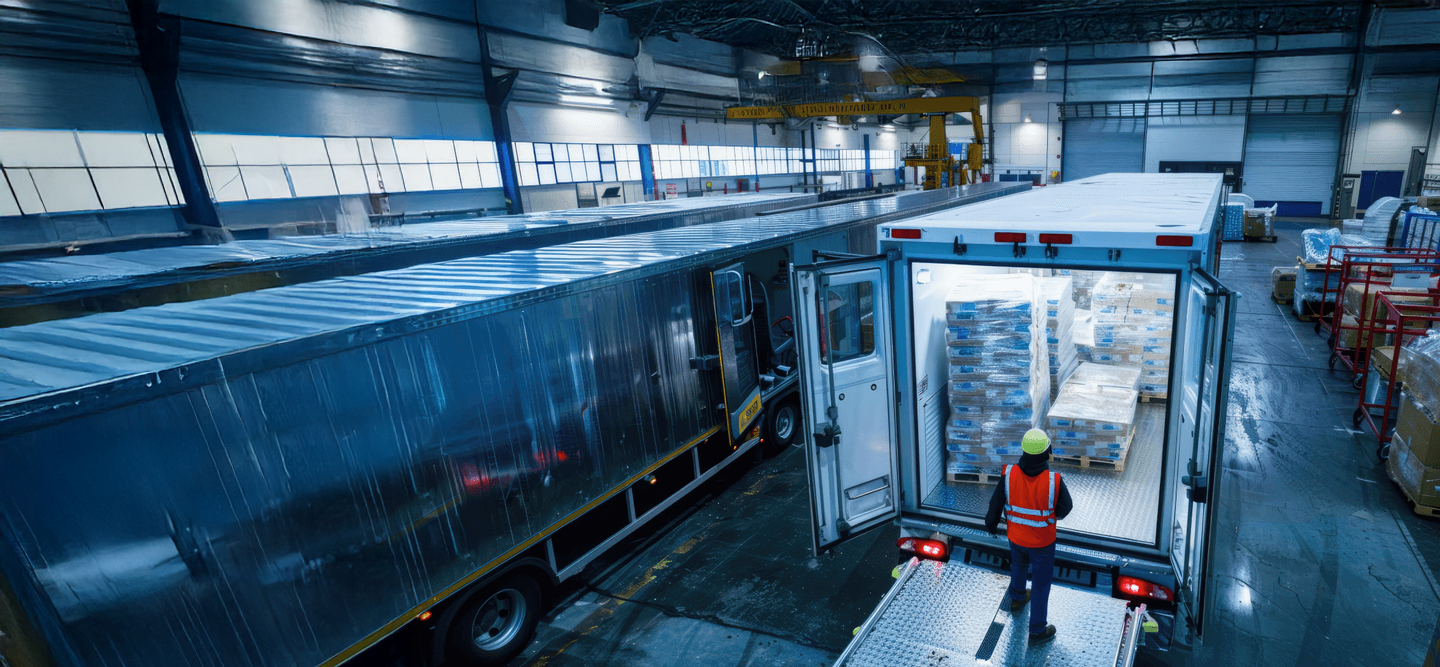
Cold chain logistics is the storage and movement of temperature-sensitive products at a set temperature, without a break. It runs from origin to sale and covers cold storage, refrigerated transport, packaging and the monitoring that proves the temperature held.
A plant head at a dairy or frozen food company meets this term the day their product leaves the factory gate. This guide explains the cold chain meaning, the five links that most often break and how to decide which links to run yourself.
| Cold chain logistics (definition) Cold chain logistics is the unbroken, temperature-controlled storage and transport of perishable or heat-sensitive goods such as dairy, frozen food, meat, produce and medicines. Each link holds a set temperature, and records prove it held. One break can spoil the whole batch. |
TL;DR
- Cold chain logistics keeps temperature-sensitive goods at a set temperature from origin to sale.
- It has five links: pre-cooling, cold storage, refrigerated transport, last-mile handling and monitoring.
- Common bands are frozen at -18 °C or below, chilled around 0 to 5 °C and pharma at 2 to 8 °C.
- India has 40.22 million tonnes of cold storage, but refrigerated transport lags far behind.
- The weakest link is usually the handover between two links, not the chamber.
- Use the link map below to decide what to own and what to outsource.
- Coldman is not the fit for ambient-only goods or very small, short-term volumes.
| Mapping your product’s cold chain for the first time? Ask Coldman which links your SKUs need → |
Why One Break Spoils the Whole Chain
A QA head at an ice cream brand knows the rule: a product is only as cold as the warmest point it passed through. Ice cream that softens in a hot dock and refreezes will show ice crystals the customer can taste.
Food and medicines rarely show the damage at once. That is why temperature records matter as much as the refrigeration itself, because they are the only proof the chain held.
FICCI and Grant Thornton Bharat estimate India loses 13.9 to 43.4 million tonnes of fruit and vegetables a year. Most of it is lost before the first cold point and in transit.
The Five Links of a Cold Chain
Every cold chain has the same five links, whatever the product. A supply chain head at a meat or seafood exporter can use this list to find the link they have not yet assigned to anyone.
- Pre-cooling or freezing at origin: bringing product to its set point fast, often with a blast freezer.
- Cold storage: chambers held at set points, with racking, door discipline and FEFO stock rotation.
- Refrigerated transport: reefer trucks or containers between sites, with set point control on the move.
- Last-mile handling: docks, cross-docks and delivery, where doors open most often.
- Monitoring and records: loggers, alarms and reports that prove each link held.
Links 3 and 4 fail most often because product changes hands there. Write down who owns each handover.
Temperature Bands and What Sits in Each
A plant manager setting up storage for a new SKU starts with its band. The label and the applicable rules decide the exact set point, so treat these as starting ranges only.
| Band | Typical range | Common products | Rule or reference |
| Frozen | -18 °C or below | Frozen meat, seafood, ready meals | FSSAI Schedule 4 hygiene conditions |
| Ice cream and desserts | Colder than general frozen | Ice cream, frozen desserts | Product label and manufacturer spec |
| Chilled | About 0 to 5 °C | Dairy, fresh meat, paneer, khoa | FSSAI Schedule 4 (5 °C or below for high-risk food) |
| Pharma cold | 2 to 8 °C | Vaccines, insulin, many biologics | Product label, WHO TRS 961 Annex 9 |
| Cool or controlled | Varies by crop or product | Some produce, chocolate, some drugs | Crop guidance or product label |
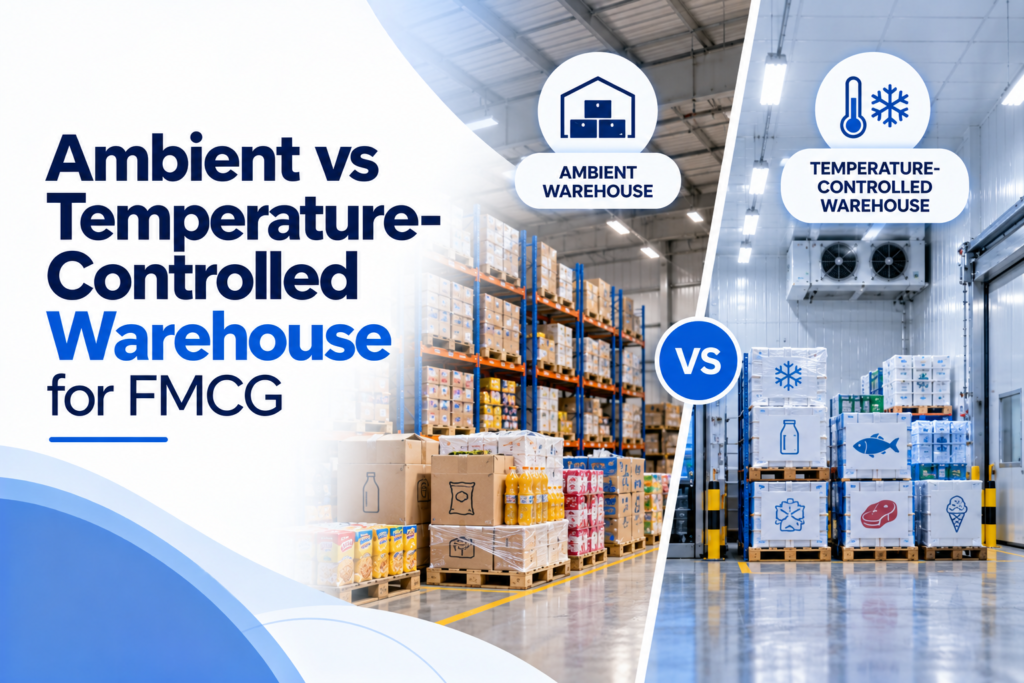
The Ambient vs Temperature-Controlled Warehouse guide covers which FMCG categories need controlled space at all.
Where India’s Cold Chain Stands in 2026
A founder planning national distribution should know where capacity sits. India’s cold storage has reached 40.22 million tonnes across 8,815 facilities, 84% of the 2037-38 need.
📊 Three-quarters of India’s cold storage holds potatoes
More than half of capacity also sits in Uttar Pradesh and West Bengal. A national total says little about multi-temperature space near your market.
> Source: FICCI and Grant Thornton Bharat via IANS, 5 Oct 2026
The sector is growing fast. DPIIT put cold chain turnover at about Rs 2 lakh crore, growing over 10% a year. In September 2026, it also began work with ADB on a grading framework for warehouses and cold chains.
Which Rules Apply to Which Cold Chain
A QA head at a company handling both food and medicines works under two separate regimes. Mixing them up is one of the most common audit mistakes.
| Product type | Main rules and references | What they focus on |
| Packaged and fresh food | FSS Act, 2006 and FSSAI Schedule 4 conditions | Licence, hygiene, temperature, traceability |
| Food for export, fish and seafood | EIA approval and MPEDA registration | Approved stores, records, traceability |
| Medicines and vaccines | Drugs and Cosmetics Rules, CDSCO GDP guidelines, WHO guidance | Premises licence, mapping, monitoring, deviations |
| Third-party audits | BRCGS Storage and Distribution, FSSC 22000 | Site-level quality and food safety systems |
The EIA Approved Cold Storage guide covers the export row in detail.
The Assumption That Cold Chain Means Cold Storage
The assumption is that cold chain logistics is mostly about cold storage. The reality is that the chamber is the most controlled link, and the breaks happen around it.
Docks, loading bays and reefer trucks see the most door openings and the most handovers. Judge any partner on how it controls those moments, not on the size of its chambers.
The Link Map: What to Own and What to Outsource
A head of supply chain can use this map to decide, link by link, whether to run it in-house, outsource it or share it. The right answer depends on volume, cities and how much evidence your customers need.
| Link | Keep in-house when | Outsource when |
| Pre-cooling and freezing | It is part of your production line | Volumes are seasonal or a third party has blast freezing near your plant |
| Cold storage | You have steady volume in one city and capital to spare | You need several cities or multiple temperature zones |
| Refrigerated transport | You run fixed, dense routes daily | Routes vary or volumes swing by season |
| Last-mile handling | You sell through your own outlets | You sell through distributors, quick commerce or marketplaces |
| Monitoring and records | Always keep access to the data | Outsource the hardware, never the visibility |
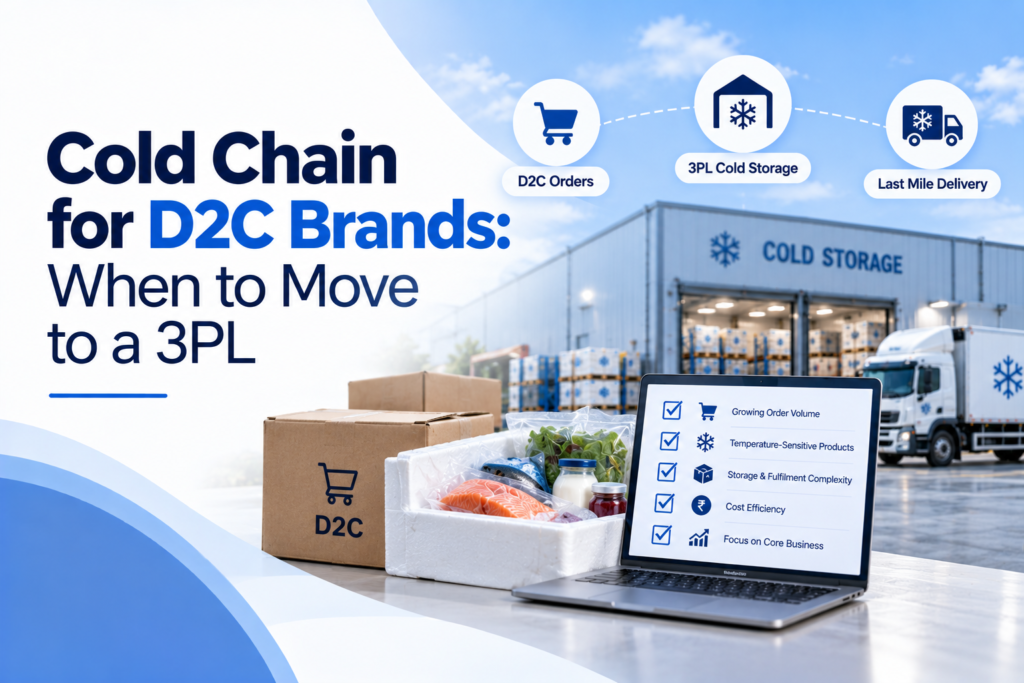
Coldman’s Technology page describes the monitoring a 3PL can run for you, including refrigeration and door-operation tracking. The Cold Chain for D2C Brands guide covers when a growing brand should outsource.
| Deciding which cold chain links to outsource? Talk to Coldman about storage and distribution in your cities → |
Five Questions Before You Outsource Any Link
A supply chain head can use these questions to test any provider for the links they decide to outsource. Each answer should come with a document.
- Which chamber or vehicle will my product use, and at what set point?
- When was that chamber mapped, and where are the loggers placed?
- Who is alerted when the temperature drifts, and how fast do they act?
- Who owns the handover records at each dock and transfer?
- Can I see live temperature and stock data, or only monthly reports?
If a provider cannot answer one of these in writing, keep that link in-house until it can. The how-to-choose guide in this series goes deeper on scoring providers.
When Coldman Is Not the Fit
A small brand with a handful of pallets for one season will find Coldman’s model too large. Coldman works on 1 to 3 year contracts with minimum-guarantee space, per its ICRA rating report.
It is also not the right partner for ambient-only goods, for cities without a Coldman site or for buyers looking for cold room equipment.
The Cost of a Broken Link
A single warm hour at a dock can turn a full batch into a write-off, a rejected delivery or a seizure. FSSAI’s 15 October 2026 advisory reminded food businesses that stock which breaks the chain can be seized and destroyed.
Map every link, name an owner for every handover and keep the records. Ask Coldman how it covers storage and distribution for the links you choose to outsource.
FAQ
What are the two types of cold chains?
Cold chains are often split into active and passive systems. Active cold chains use powered refrigeration, such as chambers and reefer trucks. Passive cold chains use insulated packaging with coolants, such as gel packs or phase change material.
What is the temperature for a cold chain?
It depends on the product. Frozen food is usually held at -18 °C or below and chilled food at about 0 to 5 °C. Many vaccines need 2 to 8 °C, and the label decides the exact set point.
What is the difference between cold storage and cold chain?
Cold storage is one link, a temperature-controlled warehouse or chamber. Cold chain is the whole sequence of storage, transport, handling and monitoring that keeps the product at its set point from origin to sale.
Which industries need cold chain logistics?
Dairy, ice cream, frozen food, meat, seafood, poultry, fresh produce, bakery, chocolate, QSR and pharma all rely on cold chains. Each has its own set points and rules.